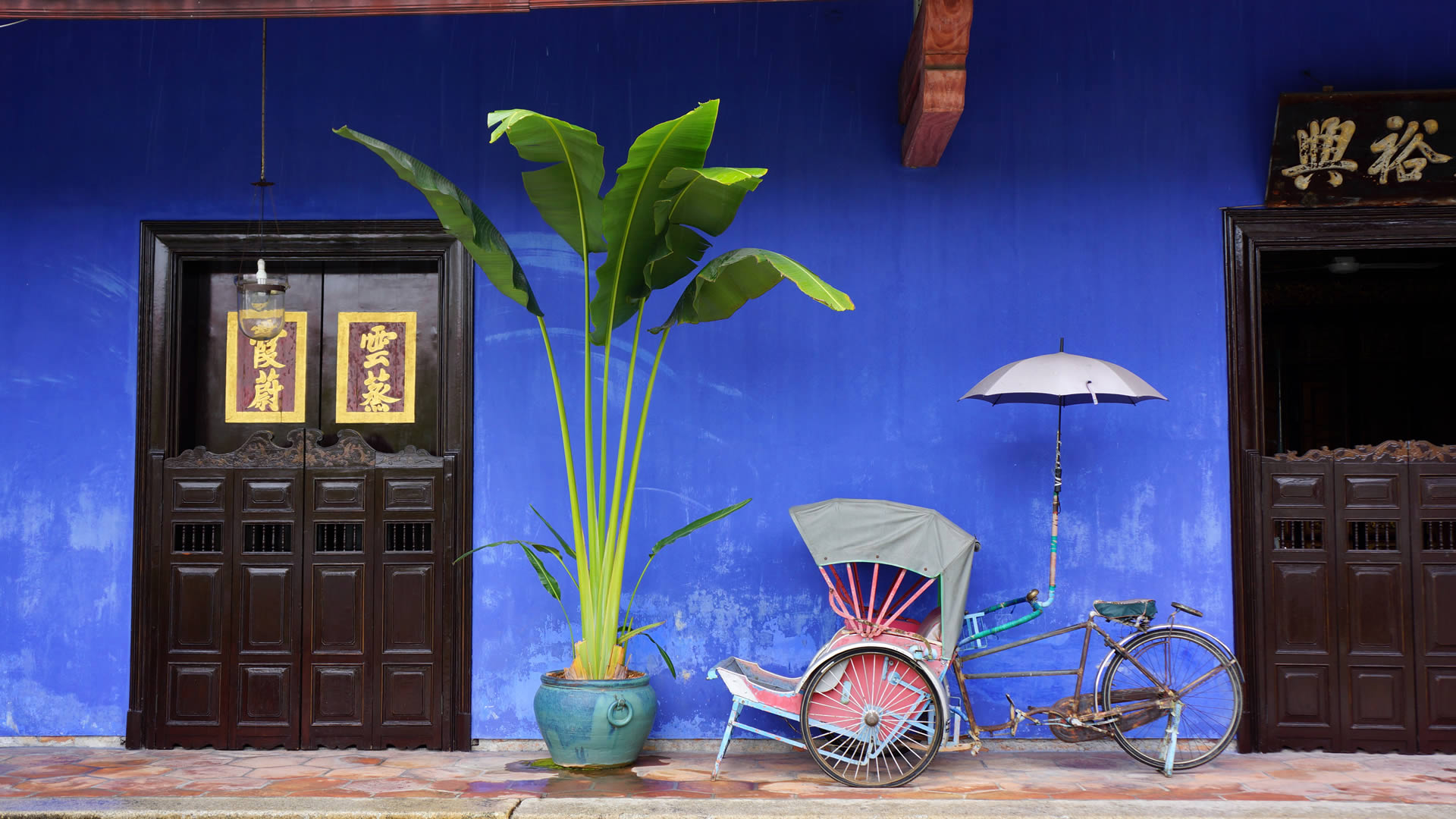
The indigo house
Our first “rendez-vous” was several years ago, at Cinemateca(a film library), where I had been told to see “Indochine”. Oh, what a cinematic experience! What a refinement, such lovely fashion details, what a sweet-bitter feeling, what a music, what a majestic acting, what an impressive beauty!…And some house! Can you remember the tango of Eliane (the wonderful Deneuve) and Camille in the saloon with rattan sofas, with blinds and walls having the colour of honey? Yes, a mythical scene, an incredible spot!
Since my first ”rendez-vous”, it has entered my “colored plan” list and I was brimming over with joy the moment when I saw it, just in front of me, at nr.14, Leith Street, in Penang, Malaysia.


Built in the 19th century, by the trader Cheong Fatt Tze, the house is one of the most important and visited structures over here, and it was designed in a Hakka traditional style- Teochew. Even though the style in which it was built was no longer tasted, those days, like the more fashionable Anglo-Indian one, Cheong decided to build his home in a traditional, Chinese style.


The indigo mansion has 38 rooms, five granite yards, seven staircases and 220 window ledges. Unfortunately, the marvelous house had its hard times, a period when it fell to ruins, because, according to the owner`s will, the house could not be sold but after the death of his eldest sun, and the savings were not enough to maintain such a large space. But, as magical places have their resources of marvels, the house was recovered and renovated starting with the year 19, by architects and extremely skilled master craftsmen who did up intricate mosaics and wood carvings, by hand. The estate has more destinations: the private residence, a boutique-hotel still under repair (with 16 rooms), it is also a little museum, which you can visit at certain hours, as I myself did, having lunch afterwards, in the same spot with a beneficial karma.


The Art Nouveau stained glasses, the elements of eastern design blended with those of western design, on the Chinese foundations, all turn the house into a unique, remarkable space.


Being declared UNESCO patrimony (in 2000 the prestigious institution awarded it the title of the Most Excellent Project Asia Pacific Heritage) and being appreciated by many televisions, being the subject of a lot of reports and documentaries on BBC, CNN, The History Chanel, being also valued by the Ministry of Culture in Malaysia, as well as by some architecture and tourism periodicals – Lonely Planet checked it on the “Greatest mansions in the world” list in 2011- it`s obviously a Penang reference place.
Colored curiosity: Cheong Fatt Tze had 8 wives, more concubines, 8 sons and 6 daughters. A big family and a highly adequate house.
Follow my blog with Bloglovin
You might also like
Life beats the movie
About what nobody told that had happened exactly 130 years ago: in 1885
Traditional eclecticism


0 Comments - Add a comment